
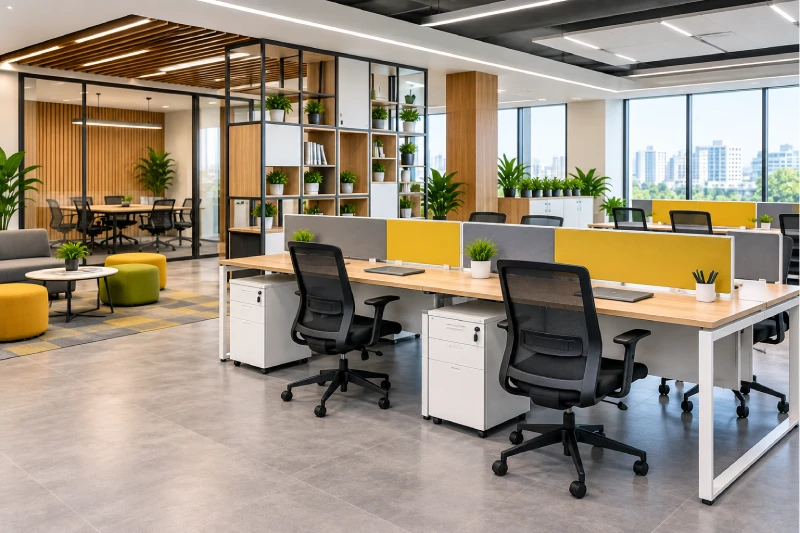
The modern office is no longer simply a collection of desks, chairs, cabins, and storage cabinets. Businesses today need workplaces that can support collaboration, individual productivity, technology, employee comfort, meetings, and changing team structures. At the same time, companies want to make better use of expensive office space and avoid replacing furniture every time their requirements change.
This is why the demand for modular office furniture in Pune is growing. Instead of relying entirely on traditional, fixed furniture arrangements, businesses are increasingly choosing flexible furniture systems that can be configured, expanded, rearranged, and customized according to their needs.
For companies setting up a new office, expanding an existing workspace, or renovating an outdated workplace, modular furniture can provide a more practical and future-ready alternative.
What Is Modular Office Furniture?
Modular office furniture refers to furniture systems made up of individual components that can be combined and arranged in different configurations. These can include workstations, desks, storage units, partitions, meeting tables, cabinets, reception furniture, and other workplace elements.
The major difference between modular and conventional furniture is flexibility.
A traditional desk or workstation may be designed for one fixed location and purpose. A modular system can be rearranged when the office layout or business requirement changes. For example, individual workstations can be grouped together for teams, separated for independent work, or expanded when new employees join.
This flexibility makes modular furniture particularly suitable for businesses where teams, departments, and working styles are constantly evolving.
Why Are Pune Businesses Moving Away from Traditional Office Setups?
Pune has a diverse commercial environment comprising IT companies, manufacturing businesses, startups, educational organizations, consulting firms, service companies, training centres, and established enterprises. Their office requirements can vary significantly depending on the size of the workforce, available floor space, work processes, and future expansion plans.
Traditional furniture can make workplace changes more difficult because it is often purchased around a fixed layout. When the business grows or the office needs to be redesigned, existing furniture may no longer fit the new configuration.
Modular furniture addresses this limitation by allowing companies to adapt the workspace without completely starting over.
1. Better Utilization of Office Space
Office space needs to be planned carefully. Simply filling an office with desks and cabinets does not guarantee an efficient workplace.
Poorly positioned furniture can create narrow walkways, unused corners, overcrowded work areas, and insufficient collaborative spaces. In contrast, space-saving office furniture can be planned according to the actual dimensions and workflow of the office.
Workstations can be positioned to maximize usable floor area while maintaining comfortable movement between departments. Storage can be integrated into appropriate areas instead of occupying unnecessary floor space.
For smaller offices, this can be particularly valuable. A well-planned modular layout can help accommodate more employees without making the workplace feel unnecessarily crowded.
Vardhaman Trading’s customized furniture approach considers available floor space, user capacity, functional requirements, project specifications, and architectural layouts when developing furniture solutions.
2. Flexibility for Growing Companies
One of the biggest disadvantages of fixed furniture is that it may not adapt easily to business growth.
Imagine a company starting with 20 employees and expanding to 40 or 50 employees within a few years. With a traditional setup, the company may need to purchase an entirely new set of furniture or undertake a major office redesign.
Modular furniture can make expansion more manageable.
Additional workstations, storage units, partitions, or other components can be incorporated into the existing setup. Departments can also be rearranged as organizational structures change.
This makes modular furniture a particularly useful option for startups, growing companies, training organizations, and businesses operating in rapidly changing sectors.
3. Modular Workstations Create More Organized Workplaces
Modular workstations for offices can help create dedicated working zones without completely separating employees into isolated cabins.
For example, a company can create four-person or six-person workstation clusters for departments that require frequent communication. Management or senior employees can have separate work areas, while meeting rooms and collaborative zones can be positioned nearby.
This type of planning can improve the flow of the workplace while maintaining a balance between collaboration and individual concentration.
The furniture layout should ultimately reflect how employees actually work rather than simply following a standard office template.
4. Ergonomics Is Becoming More Important
Employees can spend a significant portion of their working day at their desks, making furniture comfort and ergonomics important considerations when planning an office.
Modern ergonomic office furniture India solutions can include appropriately sized desks, comfortable seating, suitable workstation heights, adequate legroom, and layouts that allow employees to work without unnecessary physical strain.
Ergonomics should not be treated as an optional feature. Furniture should be selected after considering employee requirements, working duration, technology usage, and the type of tasks performed at each workstation.
For example, employees who work primarily on computers may have different requirements from employees involved in meetings, documentation, creative work, or administrative activities.
5. Customization Makes Furniture Fit the Workplace
One of the strongest advantages of modular and customized furniture is that businesses do not always have to compromise with standard dimensions.
Every office has different requirements. One workplace may need extensive storage, another may prioritize collaborative workstations, while a third may require reception furniture, executive cabins, meeting tables, and staff work areas.
Customized office furniture solutions can address these differences.
Vardhaman Trading’s customized furniture services allow organizations to consider furniture dimensions, materials, layouts, storage requirements, colours, finishes, branding elements, and specialized functional features.
This means the furniture can be planned around the workplace rather than forcing the workplace to fit a predetermined furniture system.
6. A Professional and Consistent Office Appearance
Furniture contributes significantly to how a workplace looks and feels.
Mismatched desks, outdated cabinets, bulky storage units, and inconsistent finishes can make an office appear unorganized. A coordinated modular furniture system can create a more consistent visual identity throughout the workplace.
Companies can select finishes, colours, materials, and design elements that complement their brand identity and office interiors.
For businesses that regularly receive clients, candidates, vendors, or partners at their premises, a professional workplace can also contribute to a positive first impression.
7. Easier Reconfiguration When Teams Change
Modern businesses are constantly reorganizing.
A company may create a new department, merge teams, increase its workforce, introduce hybrid working, or change the way employees collaborate. With fixed furniture, every organizational change can potentially become a furniture problem.
Modular furniture provides greater flexibility.
A workstation cluster can be divided into smaller sections. Additional desks can be added to an existing configuration. Storage can be relocated. Different areas can be created for collaboration, meetings, focused work, or administration.
This ability to reconfigure the office is one of the main reasons businesses are considering modular furniture instead of completely fixed layouts.
8. Better Integration of Storage
Storage is often overlooked during office planning.
Employees require space for documents, files, stationery, equipment, personal belongings, and other materials. If storage is added randomly after the office has already been furnished, it can consume valuable floor space.
A better approach is to integrate storage into the original office design.
Depending on the workplace, storage can include cabinets, pedestal units, shelves, cupboards, filing solutions, and department-specific storage systems.
A customized approach allows storage requirements to be considered alongside workstations and circulation areas.
9. Material Selection Matters
Choosing office furniture should not be based only on colour or appearance. The materials used can affect durability, maintenance, appearance, and long-term performance.
Depending on the application, customized institutional furniture can incorporate materials such as engineered wood, plywood, powder-coated steel structures, stainless steel components, high-pressure decorative laminates, and toughened glass elements.
The appropriate material depends on where the furniture will be used, the expected level of usage, maintenance requirements, budget, and desired appearance.
For high-traffic workplaces, durability should remain one of the primary considerations.
10. Modular Furniture Can Support Future Expansion
A workplace should not be designed only for today’s requirements.
If a company expects to expand its workforce, add departments, or move into a larger operational structure, furniture should ideally be capable of supporting that growth.
Future scalability is one of the benefits associated with customized furniture solutions. Vardhaman Trading specifically highlights scalable, future-ready designs as one of the advantages of its customized institutional furniture approach.
Planning for future requirements can reduce the need for major furniture replacement later.
Traditional vs Modular Office Furniture
The difference becomes clearer when both approaches are compared.
| Feature | Traditional Office Furniture | Modular Office Furniture |
| Layout | Generally fixed | Flexible and configurable |
| Expansion | Often requires additional redesign | Components can be added or rearranged |
| Space utilization | Depends heavily on standard sizes | Can be planned around available space |
| Customization | Usually limited | Dimensions, materials and finishes can be customized |
| Reconfiguration | More difficult | Easier |
| Long-term adaptability | Limited | Better suited to changing requirements |
| Branding | May be limited | Colours, finishes and branding can be incorporated |
| Best suited for | Stable layouts | Growing and changing workplaces |
What Should Companies Check Before Buying Modular Office Furniture?
Choosing the right supplier is just as important as choosing the right furniture.
Companies should first understand their actual requirements. This includes the number of employees, departments, available floor area, storage needs, meeting requirements, technology infrastructure, future expansion plans, and preferred workplace layout.
The quality and construction of the furniture should then be evaluated. Businesses should also ask about customization options, materials, finishes, installation, delivery schedules, and after-sales support.
For large office projects, it is particularly useful to work with a supplier that can manage the project from requirement assessment through installation rather than coordinating multiple vendors independently.
Why Work with an Experienced Furniture Supplier?
Buying office furniture in bulk involves more than selecting products from a catalogue. Large projects require accurate measurements, appropriate product selection, delivery coordination, customization, installation, and project management.
Vardhaman Trading follows a structured process that begins with understanding the client’s requirements. The company also provides live product demonstrations, allowing clients to inspect and evaluate products before making a purchasing decision. Its process covers procurement, customization, delivery, and installation.
This approach can be particularly useful for businesses furnishing an entire office or executing a workplace renovation.
Modular Furniture Is More Than a Design Trend
The growing interest in modular furniture is not simply about creating offices that look modern.
It reflects a broader change in the way businesses use workplace space. Companies need offices that can accommodate changing teams, evolving technology, different working styles, and future expansion.
A modular approach provides the flexibility to make these changes without completely replacing the furniture system.
For businesses searching for office furniture manufacturers Pune, the objective should therefore be to find a solution that combines durability, functionality, ergonomics, customization, efficient space utilization, and long-term adaptability.
Create a Workspace That Can Grow with Your Business
The traditional office setup was designed around stability. Today’s businesses increasingly need flexibility.
Modular office furniture in Pune offers a practical way to create workplaces that can adapt to changing employee numbers, departments, workflows, and space requirements. From modular workstations and storage solutions to customized desks and collaborative areas, the right furniture can make an office more organized, comfortable, and efficient.
Vardhaman Trading provides customized furniture solutions based on space, capacity, functional requirements, architectural layouts, materials, finishes, storage, and branding needs. The company also supports large-scale projects with customization and installation services.
Whether you are establishing a new office, expanding your current workplace, or redesigning an outdated setup, investing in a flexible furniture system can help you build an office that works efficiently today—and remains adaptable tomorrow.