Introduction
A classroom’s effectiveness depends not only on the quality of teaching but also on the tools that support the learning process. Among the most important teaching aids, whiteboards and writing boards continue to play a vital role in schools, colleges, coaching centers, and training institutes. However, selecting the right board stands for classrooms is just as important as choosing the board itself.
Today, educational institutions have two popular options: the fixed board stand and the revolving board stand. While both are designed to provide a stable writing surface, they differ significantly in functionality, flexibility, and classroom applications.
Choosing between the two requires understanding how each stand contributes to teaching efficiency, classroom management, and student engagement. This guide explores their features, benefits, and ideal use cases to help institutions make the right decision.
The Importance of Quality Board Stands in Educational Spaces
Modern classrooms are becoming increasingly interactive. Teachers use boards for explaining concepts, solving numerical problems, drawing diagrams, conducting discussions, and presenting lesson plans. A reliable classroom whiteboard stand ensures that information is clearly visible while providing a smooth writing experience.
Well-designed board stands offer several advantages:
- Better visibility for students.
- Improved teaching efficiency.
- Organized classroom presentations.
- Enhanced durability and long-term performance.
- Flexibility for different teaching methods.
- Professional classroom appearance.
The right board stand can significantly improve the overall learning environment.
What Is a Fixed Board Stand?
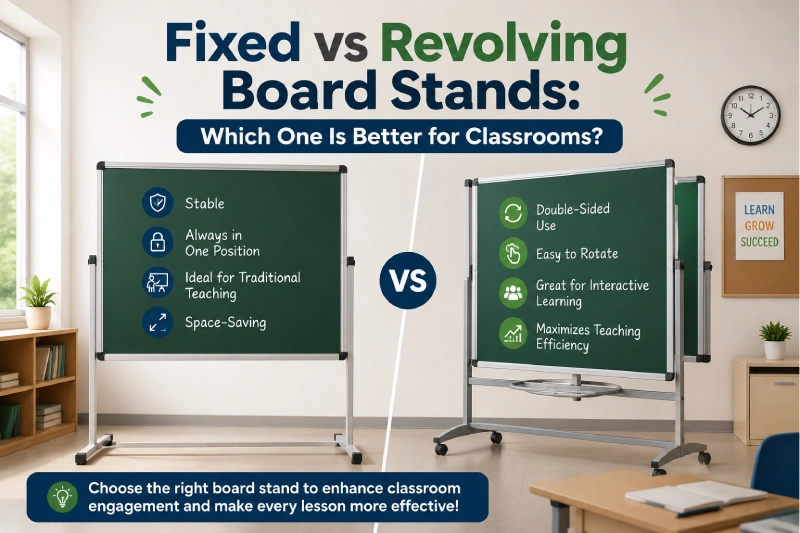
A fixed board stand is a traditional board support system where the board remains stationary. It is mounted securely on a durable frame and provides a stable writing surface for daily classroom use.
Fixed board stands are commonly found in schools and institutions that follow conventional teaching methods and require a straightforward, dependable solution.
Key Features of Fixed Board Stands
- Stationary and non-rotating design.
- Strong structural stability.
- Easy installation and maintenance.
- Durable construction for daily use.
- Cost-effective classroom solution.
Because of their simple design, fixed stands remain one of the most widely used board systems in educational institutions.
Benefits of Fixed Board Stands
1. Excellent Stability
One of the biggest advantages of a fixed board stand is its stability. Since the board remains firmly positioned, teachers can write comfortably without any movement or vibration.
This makes fixed stands ideal for subjects that require continuous writing, such as mathematics, science, and language instruction.
2. Budget-Friendly Investment
Educational institutions often need to furnish multiple classrooms while managing costs. Fixed board stands offer a practical and economical solution without compromising durability.
3. Easy Maintenance
With no rotating mechanisms or moving parts, fixed stands require minimal maintenance. This makes them particularly suitable for institutions looking for low-maintenance teaching equipment.
4. Long-Term Durability
Fixed board stands are built to withstand years of classroom use. Their simple construction reduces wear and tear while ensuring consistent performance.
5. Ideal for Traditional Classrooms
Schools and colleges that follow lecture-based teaching methods often find fixed board stands sufficient for their daily requirements.
Best Applications
Fixed board stands work well in:
- Primary schools
- Secondary schools
- Colleges
- Examination rooms
- Training classrooms
- Tuition centers
What Is a Revolving Board Stand?
A revolving board stand is a more advanced classroom solution that allows the board to rotate around a central axis. This design provides access to both sides of the board, effectively doubling the available writing space.
Revolving boards have become increasingly popular in modern educational institutions because they support dynamic and interactive teaching methods.
Key Features of Revolving Board Stands
- Double-sided writing surface.
- Smooth revolving mechanism.
- Space-efficient design.
- Enhanced classroom functionality.
- Suitable for extensive teaching sessions.
- Professional appearance.
The ability to rotate the board provides teachers with greater flexibility and convenience during lessons.
Benefits of Revolving Board Stands
1. Double Writing Space
The most significant advantage of a revolving board stand is the availability of two writing surfaces.
Teachers can write on one side, rotate the board, and continue teaching without erasing previous content. This is particularly useful for lengthy lectures and detailed explanations.
2. Better Time Management
Frequent erasing can interrupt lesson flow and consume valuable teaching time. Revolving boards allow educators to switch surfaces instantly, ensuring smoother transitions between topics.
3. Supports Interactive Teaching
Modern teaching methods often involve diagrams, charts, problem-solving exercises, and group discussions. Revolving boards make it easier to organize information and present lessons more effectively.
4. Ideal for Technical Subjects
Subjects such as engineering, mathematics, accounting, and science often require extensive board work. The additional writing space offered by revolving boards makes them highly effective for these disciplines.
5. Improved Classroom Productivity
With more space available for explanations and examples, teachers can conduct lessons more efficiently while students can follow concepts more clearly.
Best Applications
Revolving board stands are ideal for:
- Universities
- Engineering colleges
- Coaching institutes
- Professional training centers
- Seminar halls
- Corporate training rooms
Fixed Board Stand vs Revolving Board Stand
Writing Capacity
Fixed Board Stand
- Single writing surface.
- Suitable for standard classroom teaching.
Revolving Board Stand
- Dual writing surfaces.
- Provides nearly double the writing area.
Teaching Flexibility
Fixed Board Stand
- Best for structured and traditional teaching methods.
Revolving Board Stand
- Supports dynamic and interactive teaching styles.
Space Utilization
Fixed Board Stand
- Efficient for smaller classrooms.
Revolving Board Stand
- Maximizes writing space without requiring additional wall area.
Maintenance Requirements
Fixed Board Stand
- Minimal maintenance due to simple construction.
Revolving Board Stand
- Requires occasional inspection of rotating components.
Cost Consideration
Fixed Board Stand
- More affordable initial investment.
Revolving Board Stand
- Higher upfront cost but greater functionality.
Overall Productivity
Fixed Board Stand
- Suitable for regular classroom activities.
Revolving Board Stand
- Enhances lesson continuity and teaching efficiency.
Which Option Is Better for Modern Classrooms?
The answer depends on the institution’s requirements.
A fixed board stand is an excellent choice when:
- Budget is a primary consideration.
- Teaching methods are traditional.
- Classroom activities require limited board space.
- Low maintenance is preferred.
A revolving board stand is the better option when:
- Teachers need extensive writing space.
- Lessons involve complex diagrams and calculations.
- Interactive teaching methods are encouraged.
- Classroom efficiency is a priority.
For institutions aiming to create future-ready learning environments, revolving board stands often provide greater long-term value.
Factors to Consider Before Purchasing
Classroom Size
Larger classrooms generally benefit more from revolving boards due to their enhanced visibility and functionality.
Subject Requirements
Technical and analytical subjects often require more writing space, making revolving stands highly beneficial.
Student Strength
Classrooms with larger student groups may need solutions that support extended explanations and improved content visibility.
Durability
Educational furniture should withstand continuous daily usage while maintaining performance and appearance.
Future Expansion
Institutions planning to modernize classrooms may find revolving board stands more adaptable to evolving teaching methods.
Why Educational Institutions Trust Quality Classroom Furniture
Furniture and teaching aids directly impact the effectiveness of the learning environment. Institutions increasingly seek solutions that combine durability, functionality, and professional design.
Vardhaman Trading has established itself as a trusted provider of educational and institutional furniture solutions. Their focus on quality manufacturing, durable materials, and practical designs helps schools, colleges, and training institutes create classrooms that support both teachers and students effectively.
By investing in the right classroom infrastructure, institutions can improve learning experiences while maximizing long-term value.
Conclusion
Both fixed board stands and revolving board stands offer valuable benefits for educational institutions. Fixed stands provide a dependable, economical, and low-maintenance solution for traditional classrooms. Revolving stands, on the other hand, deliver enhanced flexibility, greater writing space, and improved teaching efficiency for modern learning environments.
When choosing board stands for classrooms, institutions should evaluate their teaching methods, classroom size, budget, and long-term educational objectives. While fixed stands remain a reliable choice, revolving board stands are increasingly becoming the preferred solution for schools and colleges looking to support interactive and engaging teaching practices.
Ultimately, the right classroom whiteboard stand is one that empowers educators, enhances student engagement, and contributes to a more productive learning experience.