
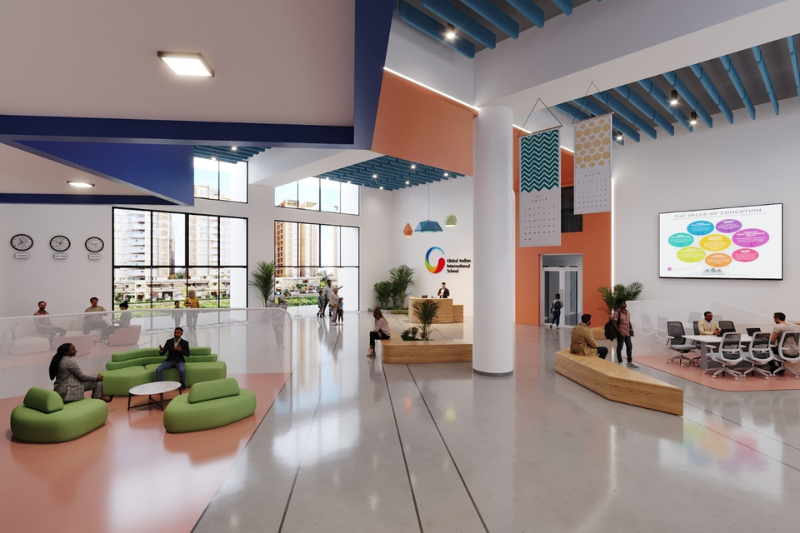
Client Profile
Global Indian International School (GIIS) is one of the leading international school networks known for maintaining high standards in infrastructure, learning environments, and student facilities. When developing and upgrading their campuses, GIIS places strong emphasis on quality, durability, safety, and uniformity across locations.
The Opportunity
Vardhaman Trading Company received an enquiry from GIIS International School, Amanora Town, for a comprehensive classroom furniture and educational infrastructure requirement. The project was not limited to supplying products; it involved creating a consistent learning experience across multiple campuses.
The requirement included:
- Maroon Magnetic Boards with Wooden Frames
- White Boards with Wooden Frames
- Injection Moulded Desks
- Cubby Holes
- Student Lockers
At first glance, the requirement appeared straightforward. However, during discussions with the client, it became clear that the project carried significant expectations regarding quality, standardization, and execution.
The school management wanted every product supplied to reflect the same level of quality, appearance, and functionality regardless of the campus location.
Understanding the Client’s Expectations
Educational institutions invest heavily in infrastructure because classroom environments directly impact student learning, organization, and overall experience.
GIIS was looking for a partner who could:
- Understand educational furniture requirements in detail.
- Provide products that were durable enough for daily student usage.
- Maintain consistency in design and finish.
- Deliver within committed timelines.
- Support execution across multiple locations.
The client was particularly focused on creating a standardized environment for students. Every classroom, storage unit, and learning space needed to maintain the same visual identity and functionality.
This requirement would later become the defining challenge of the project.
Our Response
Understanding the importance of the opportunity, the Vardhaman Trading team immediately initiated a structured project execution process.
Requirement Analysis
Our team conducted detailed discussions with the school administration to understand:
- Classroom layouts
- Student capacity requirements
- Product specifications
- Durability expectations
- Aesthetic preferences
- Installation timelines
Rather than simply submitting prices, we focused on understanding how the products would be used daily by students and staff.
Sample Development
Since product quality was a major evaluation criterion, we arranged and submitted samples of the required items for inspection and approval.
The samples allowed the client to assess:
- Material quality
- Product finish
- Structural strength
- Design suitability
- Colour consistency
- Ease of maintenance
This stage was critical because it established confidence in our ability to deliver exactly what was promised.
Timely Submission
Within 15–20 days of receiving the enquiry, we successfully submitted:
- Product samples
- Technical specifications
- Commercial quotation
- Delivery commitments
The quick turnaround demonstrated our responsiveness and commitment to the project.
The Challenge: Multi-City Standardization
Following evaluation of the samples and quotation, Vardhaman Trading Company was awarded the order.
However, the project came with a crucial condition.
The products were required for two different campuses:
- Pune
- Bangalore
The school management clearly communicated that all materials supplied to both locations had to be exactly identical.
This meant:
- Same dimensions
- Same colour shades
- Same material specifications
- Same design details
- Same finishing quality
- Same user experience
Even minor differences between locations would not be acceptable.
For many suppliers, maintaining such consistency across separate deliveries can become a significant challenge due to variations in manufacturing batches, procurement sources, transportation conditions, and installation practices.
Our Execution Strategy
To ensure complete standardization, we implemented a strict quality control and project management process.
Product Standardization
Every approved sample became the benchmark for production and procurement.
Our team ensured that:
- All products were sourced according to approved specifications.
- Materials were matched precisely to sample standards.
- Quality checkpoints were established before dispatch.
- Finishing and workmanship were inspected thoroughly.
Centralized Quality Monitoring
Before shipment, each product category underwent inspection to verify:
- Structural integrity
- Surface finish
- Colour consistency
- Dimension accuracy
- Functional performance
This prevented deviations between the Pune and Bangalore supplies.
Logistics Coordination
Delivering to two different cities required careful planning and coordination.
The team scheduled dispatches strategically to ensure:
- Timely delivery
- Safe transportation
- Proper handling
- Installation readiness
By closely monitoring every stage of the process, we maintained consistency from dispatch to final installation.
Successful Project Completion
The project was executed successfully at both campuses.
Despite the geographical distance between Pune and Bangalore, every supplied product maintained the same specifications and visual standards approved by the client.
The school administration appreciated:
- Product quality
- Professional communication
- Timely execution
- Attention to detail
- Consistency across locations
Most importantly, the key project objective—uniformity between campuses—was achieved successfully.
Building Trust Beyond the First Order
In institutional projects, successful delivery is only one measure of success.
The true indicator of client satisfaction is repeat business.
Following the successful completion of the classroom furniture project, GIIS once again approached Vardhaman Trading Company for additional infrastructure requirements.
The trust established during the first project led to new orders for:
Chemistry Laboratory Infrastructure
The subsequent project involved providing solutions for the school’s chemistry laboratory facilities, further expanding our scope of work with the institution.
Receiving repeat orders demonstrated the confidence the client had developed in our:
- Product quality
- Reliability
- Project execution capabilities
- Commitment to customer satisfaction
Project Outcomes
Key Achievements
✔ Samples and quotation submitted within 15–20 days.
✔ Successfully secured the project after evaluation.
✔ Supplied educational furniture and infrastructure for both Pune and Bangalore campuses.
✔ Maintained complete product consistency across locations.
✔ Met quality and delivery expectations.
✔ Established a long-term relationship with the client.
✔ Earned repeat business through successful project execution.
Conclusion
The GIIS International School project stands as an excellent example of Vardhaman Trading Company’s ability to manage complex institutional requirements with precision and professionalism.
What began as an enquiry for classroom furniture evolved into a multi-location project that demanded strict quality control, seamless coordination, and unwavering attention to detail. By delivering identical products across two cities while maintaining the highest standards of quality, Vardhaman Trading Company successfully met the client’s expectations and built a lasting partnership.
The subsequent Chemistry Laboratory project further reinforced the trust earned through this engagement, making the GIIS project a testament to our commitment to quality, consistency, and customer satisfaction in every educational infrastructure solution we deliver.