
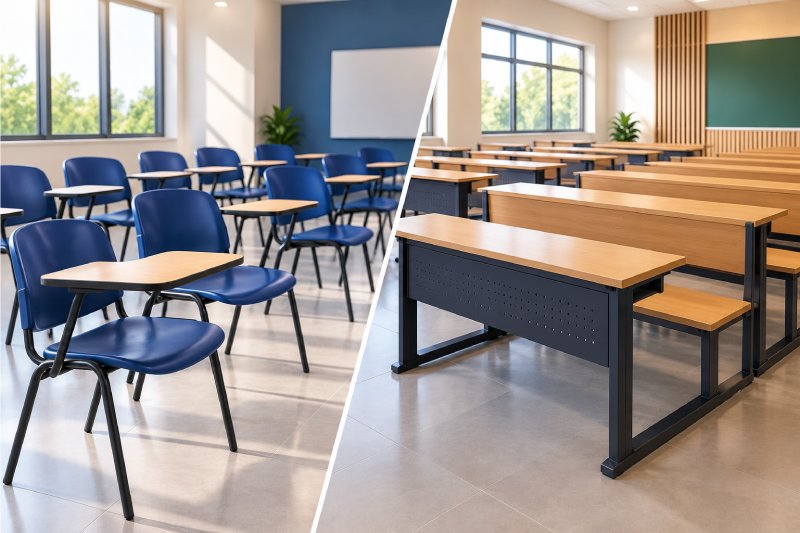
Choosing the right writing pad chair or desk-bench unit can significantly influence how a college classroom functions. Unlike school classrooms, college spaces often accommodate adult students, longer lectures, laptops, group discussions and changing teaching formats. This makes seating selection an important part of classroom planning.
Both options have practical advantages. The right choice depends on room size, teaching style, student capacity, expected usage and how frequently the classroom needs to be rearranged.
What Is a Writing Pad Chair?
A writing pad chair, also called a tablet arm chair, combines a student chair with an attached writing surface. Instead of using a separate desk, students have a compact platform for notebooks, tablets or laptops.
This design is particularly useful where floor space is limited. Rows of chairs can create a clean layout while leaving more room for movement and circulation. Writing-pad models are also commonly used in lecture halls, seminar rooms, training centres and examination spaces.
For larger lecture environments, Vardhaman Trading offers writing-pad seating among its auditorium seating configurations, with options that can be adapted to the venue and seating layout.
What Are Desk-Bench Units?
Desk-bench units combine a writing desk and one or more seats into a single classroom unit. They are a familiar choice for educational institutions because they provide a dedicated writing surface and stable seating arrangement.
Vardhaman Trading’s classroom benches are available in single-seater, dual-seater and multi-seater configurations, with options for different desk layouts, writing surfaces, storage and frame specifications.
For college classrooms, desk-bench units can be particularly practical when students regularly work with textbooks, notebooks and other learning materials.
Writing Pad Chair vs Desk-Bench: Key Differences
| Factor | Writing Pad Chair | Desk-Bench Unit |
| Space usage | Compact and efficient | Requires more floor area |
| Seating flexibility | Easy to rearrange individually | Usually arranged in fixed units |
| Writing surface | Attached tablet arm | Dedicated desk surface |
| Storage | Usually limited | Storage can be incorporated |
| Group activities | Easy to reconfigure | Less flexible depending on design |
| Large lecture rooms | Suitable | Suitable |
| Long writing sessions | Depends on pad size | Larger writing area available |
| Maintenance | Individual components | Integrated desk-bench structure |
Space and Classroom Flexibility
If a college regularly changes classroom layouts for lectures, workshops, presentations or examinations, a study chair with writing pad can provide greater flexibility. Individual chairs can be repositioned without moving an entire desk unit.
Desk benches, on the other hand, can create an orderly arrangement and make efficient use of classrooms where the seating layout remains relatively consistent.
Vardhaman Trading’s college furniture solutions include lecture halls, seminar rooms, libraries, laboratories and other academic spaces, with customized layouts available according to campus requirements.
Comfort and Writing Space
Comfort depends not only on the chair but also on the size and position of the writing surface. A tablet arm chair should provide adequate support for the student’s notebook or laptop without restricting movement.
Desk-bench units generally provide a larger, more stable work surface. This can be useful for courses where students spend extended periods writing or working with multiple study materials.
For longer lectures, colleges should also consider seat dimensions, back support, legroom and the spacing between rows rather than evaluating furniture purely by appearance.
Durability and Maintenance
College furniture experiences frequent daily use, so frame strength, surface quality and ease of maintenance matter. Vardhaman Trading describes its classroom benches as having sturdy steel frameworks, scratch-resistant writing surfaces and designs intended for intensive institutional use.
Writing pad chairs should similarly be evaluated for the strength of the tablet mechanism, chair frame, fasteners and writing surface. In high-traffic classrooms, robust construction can help reduce frequent repairs and replacements.
Which Should Your College Choose?
There is no single seating format suitable for every college classroom.
Writing pad chairs can work well for lecture halls, seminar rooms, training spaces and classrooms where flexibility and efficient space utilization are priorities.
Desk-bench units can be practical for conventional classrooms where students require a larger writing area and the seating arrangement is relatively fixed.
Many institutions may also use both solutions across different areas of the campus. The important step is to match the furniture to the way each room will actually be used.
Plan College Classroom Seating Before Bulk Purchase
Before ordering, assess classroom dimensions, number of students, aisle requirements, teaching methods, laptop usage and whether the room needs frequent reconfiguration. A physical demonstration can also help administrators evaluate comfort, writing space and construction quality before committing to a bulk order.
Vardhaman Trading has supplied college furniture in Pune and Maharashtra since 2002 and provides customized solutions, bulk supply, installation and free on-site demonstrations for educational institutions.
Planning a new college classroom or upgrading existing seating? Explore suitable writing-pad chairs and desk-bench configurations with Vardhaman Trading.