
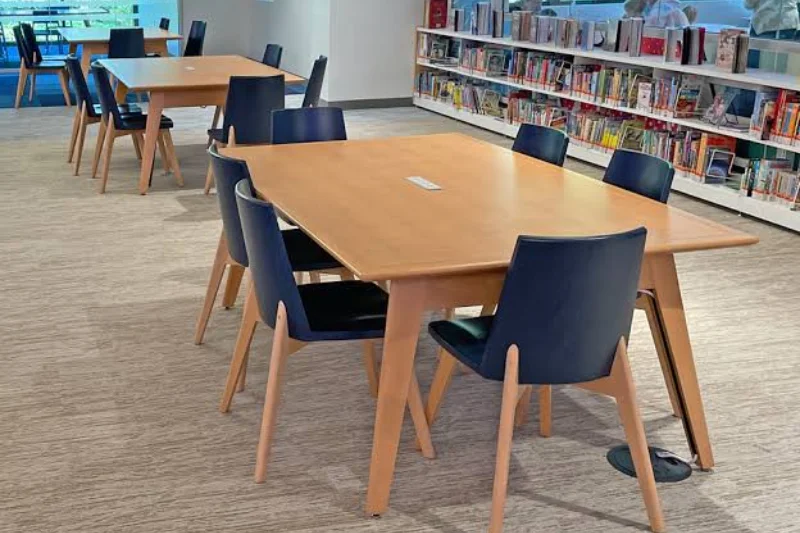
A library is one of the busiest and most important learning spaces in any educational institution. Whether it is a school library, college reading room, university resource centre, coaching institute, or public library, the furniture inside the space has to support hundreds of users over long periods.
Among all library furniture, tables experience some of the most consistent daily use. Students read books, write notes, use laptops, prepare assignments, attend study sessions, and sometimes work in groups around these tables. The furniture is cleaned regularly, chairs are moved repeatedly, and the surfaces are exposed to books, stationery, bags, electronic devices, and accidental spills.
This raises an important question for institutions planning or upgrading their libraries:
When comparing wooden vs metal library tables, which material lasts longer under high-volume daily use?
The answer isn’t as simple as saying one material is always better. Both wooden and metal tables have their own strengths. The right choice depends on the construction quality, surface finish, type of use, maintenance requirements, expected student traffic, budget, and overall library design.
Let’s explore the differences in detail.
Why Choosing the Right Library Table Matters
Library furniture is a long-term investment. Unlike residential furniture, institutional furniture may be used continuously for several hours every day by different users.
A table installed in a school or college library may be expected to remain functional for many years. During this period, it may experience thousands of hours of use.
This makes library table durability a critical consideration.
A suitable table should ideally provide:
- Structural stability
- Good load-bearing capacity
- Resistance to everyday wear
- A durable working surface
- Easy cleaning
- Comfortable use for extended periods
- Reliable joints and fittings
- A finish suitable for institutional environments
- Long-term value for the institution
Selecting the right material at the beginning can therefore help reduce future maintenance, repair, and replacement requirements.
Understanding Wooden Library Tables
Wooden library tables have traditionally been a popular choice for educational and reading environments. They can create a warm, comfortable, and sophisticated atmosphere that complements the quiet nature of a library.
However, “wooden table” can refer to several different construction types. Solid wood, plywood, MDF, particle board, laminate-finished boards, and veneered surfaces can all have different performance characteristics.
Therefore, institutions should evaluate the actual material specification rather than simply choosing a product because it is labelled as wooden.
Advantages of Wooden Library Tables
1. Warm and Welcoming Appearance
One of the biggest advantages of wood-based furniture is its appearance.
Libraries are spaces where students may spend several hours studying. A warm wood finish can make the environment feel more comfortable and inviting.
Wooden tables can also coordinate easily with:
- Bookshelves
- Library counters
- Storage cabinets
- Display units
- Reading chairs
- Reception desks
- Interior wall finishes
This makes them suitable for institutions that want a cohesive and professional library interior.
2. Comfortable for Long Study Sessions
The surface of a library table plays an important role in user comfort.
Students may spend several hours writing, reading textbooks, preparing assignments, or working on laptops. A properly finished wood-based surface provides a familiar and comfortable working area.
This can be particularly valuable in quiet reading rooms where students are expected to remain seated for extended periods.
3. Flexible Design Options
Wood-based furniture offers considerable flexibility in terms of design.
Institutions can choose from different:
- Colours
- Laminates
- Textures
- Edge profiles
- Shapes
- Table sizes
- Surface finishes
A school may choose a simple rectangular table, while a university may prefer a larger collaborative reading table.
4. Easy Interior Coordination
Wood finishes can complement both traditional and modern library designs.
A darker finish may create a classic academic atmosphere, while a lighter finish can make a smaller reading room appear brighter and more open.
This flexibility makes wooden furniture attractive for institutions that place considerable emphasis on interior aesthetics.
Limitations of Wooden Library Tables
Although quality wooden furniture can be durable, institutions should understand its potential limitations.
Moisture Sensitivity
Depending on the type of wood or engineered board used, prolonged exposure to moisture can cause swelling, warping, or deterioration.
This doesn’t mean wooden tables cannot be used in institutional environments. It simply means the material, edge treatment, and finish should be selected carefully.
Surface Damage
Wood-based surfaces can be affected by scratches, impact, excessive moisture, or unsuitable cleaning products.
The quality of the laminate, veneer, or other surface treatment plays a major role in determining how well the table handles daily use.
Edge Durability
The edges of tables are frequently exposed to impact from chairs, bags, cleaning equipment, and everyday movement.
Poor-quality edge finishing can result in chipping or peeling over time.
For high-use libraries, institutions should therefore pay attention not only to the tabletop but also to its edge treatment and overall construction.
Understanding Metal Library Tables
Metal library tables generally use a metal or steel frame to provide structural support. The tabletop may itself be metal or, more commonly in institutional furniture, combined with another surface material.
Metal is particularly attractive for high-use environments because of its structural strength and ability to withstand repeated daily use.
Advantages of Metal Library Tables
1. Strong Structural Performance
A well-designed metal frame can provide excellent stability.
This is particularly important in busy libraries where tables may be subjected to:
- Frequent use
- Repeated movement
- Uneven pressure
- Heavy books
- Laptop equipment
- Accidental impacts
A strong metal structure can help the table remain stable over extended periods.
2. Suitable for High-Traffic Environments
A school or college library can experience continuous student movement throughout the day.
Students sit down, stand up, move chairs, place bags under tables, and rearrange seating.
This makes structural durability particularly important.
Metal frames are often well suited to high-traffic library furniture because they can provide strong support while maintaining a relatively practical design.
3. Lower Routine Maintenance
Metal surfaces and frames can generally be cleaned easily as part of regular housekeeping.
A properly finished metal frame does not require the same type of surface care associated with certain wood finishes.
This can be beneficial for large institutions where maintenance teams have to manage hundreds of pieces of furniture.
4. Good Resistance to Everyday Wear
Quality metal furniture can handle repeated use effectively when properly manufactured and finished.
However, the protective coating remains important. Scratches that expose untreated metal should not simply be ignored, particularly in environments where moisture may be present.
Limitations of Metal Library Tables
Metal is not automatically maintenance-free.
Surface Scratches
Painted or powder-coated metal can develop scratches from repeated contact with chairs, bags, equipment, and other furniture.
A damaged coating should be addressed appropriately to maintain the appearance and long-term protection of the frame.
Appearance
While modern metal furniture can look sophisticated, some institutions may prefer the warmth of wood-based furniture for traditional reading spaces.
The choice therefore depends partly on the desired atmosphere.
Comfort
A completely metal tabletop may not provide the same tactile comfort as a properly finished wood-based surface.
For this reason, many institutional designs use metal for the structural frame and a wood-based material for the tabletop.
Wooden vs Metal Library Tables: Detailed Comparison
When conducting a library table material comparison, institutions should consider several factors rather than focusing exclusively on durability.
| Factor | Wooden Library Tables | Metal Library Tables |
| Structural strength | High with quality construction | Very high with suitable design |
| Visual appeal | Warm and traditional | Modern and functional |
| Surface comfort | Excellent | Depends on tabletop design |
| Moisture resistance | Depends on material and finish | Generally strong with proper coating |
| Maintenance | Moderate | Generally straightforward |
| Design flexibility | Very high | High |
| Scratch resistance | Depends on surface finish | Depends on coating |
| Heavy-use suitability | Excellent when properly constructed | Excellent |
| Long-term performance | High-quality products can last for years | High-quality products can last for years |
| Best application | Reading-focused interiors | Heavy-use institutional environments |
This comparison shows why material choice should be based on application rather than a simple “wood versus metal” decision.
The Importance of Construction Quality
Material is only one part of the durability equation.
Two tables made from the same material can have completely different service lives.
Why?
Because construction quality matters.
For example, a metal table with poorly welded joints or weak fasteners may become unstable despite having a strong frame material.
Similarly, a wooden table made from low-quality boards may deteriorate much faster than a properly constructed table using high-quality materials and suitable edge protection.
When selecting library furniture, institutions should therefore consider:
- Frame design
- Joint quality
- Fasteners
- Tabletop thickness
- Edge finishing
- Surface treatment
- Load capacity
- Stability
- Overall workmanship
A durable material combined with poor construction will not necessarily produce durable furniture.
Institutional Table Finish: Why It Matters
One of the most overlooked factors in furniture selection is the finish.
The finish protects the surface from everyday use and also influences the appearance of the furniture.
For wood-based tables, the institutional table finish may include laminate, veneer, melamine, or another suitable surface treatment.
A quality finish can help protect against:
- Minor scratches
- Stains
- Everyday dirt
- Frequent cleaning
- Surface wear
For metal furniture, protective coatings such as powder coating can help improve appearance and protect the underlying material.
Therefore, when comparing tables, don’t just ask:
“Is it wood or metal?”
Also ask:
“How is the material finished and protected?”
Which Table Is Better for a High-Traffic Library?
A high-traffic library has different requirements from a small private reading room.
Consider a college library with hundreds of students using the facility every day.
The furniture needs to withstand:
- Constant seating and movement
- Heavy books
- Laptops and electronic devices
- Frequent cleaning
- Repeated chair movement
- Accidental impacts
- Long operating hours
In such an environment, structural strength becomes particularly important.
Metal frames can offer excellent performance in this regard.
However, the tabletop still needs to provide a comfortable writing and reading surface.
This is why a hybrid approach can be particularly effective.
Why Hybrid Library Tables Can Be an Excellent Choice
Instead of choosing completely wooden or completely metal furniture, institutions can combine the two materials.
A typical hybrid library table may use:
Metal/steel frame + durable wood-based tabletop
This design combines the strengths of both materials.
The metal frame provides:
- Structural stability
- Strength
- Long-term support
- Resistance to repeated movement
The tabletop provides:
- Comfortable working surface
- Attractive appearance
- Design flexibility
- Easy integration with library interiors
For many schools and colleges, this can be a practical solution for high-traffic library furniture.
What About Cost?
Initial price is an important consideration, particularly when an institution is furnishing an entire library.
However, the cheapest option is not necessarily the most economical option in the long run.
Suppose an institution purchases a low-cost table that requires frequent repairs or replacement.
The initial saving may eventually disappear because of:
- Repair costs
- Replacement costs
- Maintenance labour
- Disruption to library operations
- Furniture disposal
- Installation of replacement units
Instead, institutions should think about total cost of ownership.
This means considering the purchase price alongside expected lifespan, maintenance, repair requirements, and replacement frequency.
A slightly more expensive table with better construction and finish may provide greater long-term value.
Maintenance Considerations for Wooden Tables
Maintaining wooden library tables does not have to be complicated, but consistency is important.
Institutions should:
- Clean surfaces regularly using suitable cleaning methods.
- Avoid excessive water exposure.
- Address spills promptly.
- Check table edges for damage.
- Inspect joints periodically.
- Avoid harsh chemicals that may damage the finish.
- Repair significant surface damage when necessary.
Regular maintenance can help extend the usable life of quality wooden furniture.
Maintenance Considerations for Metal Tables
Metal tables and frames are generally straightforward to maintain.
Institutions should:
- Clean surfaces regularly.
- Inspect frames and joints.
- Check for loose fasteners.
- Address coating damage.
- Prevent prolonged moisture exposure.
- Replace damaged components when necessary.
The condition of the protective finish is particularly important because it contributes to the long-term appearance and protection of the metal.
Library Design Should Consider Student Comfort
Durability should never come at the expense of usability.
A library table is ultimately designed for students and readers.
Students may spend hours at the same table, which means factors such as:
- Table height
- Legroom
- Surface space
- Seating arrangement
- Edge comfort
- Stability
- Laptop usability
all matter.
A table can be extremely strong but still unsuitable if students find it uncomfortable to use.
Therefore, the best institutional furniture balances durability with ergonomics and usability.
Choosing Tables Based on Library Type
Different libraries may require different furniture solutions.
School Libraries
School libraries typically need furniture that is durable, easy to clean, safe, and comfortable for younger users.
A combination of durable tabletops and strong frames can provide a practical solution.
College Libraries
College libraries generally experience heavier and more continuous usage.
Students may use the space for long study sessions, group projects, examinations, and laptop-based learning.
Here, durability and stability become particularly important.
University Libraries
University libraries can operate for long hours and accommodate large numbers of students.
Furniture should therefore be selected for intensive institutional use, with strong attention to durability, maintenance, and long-term value.
Coaching Institute Libraries
Coaching centres often have limited space but high student turnover.
Tables need to be compact, stable, easy to maintain, and capable of handling repeated use throughout the day.
What Should Institutions Check Before Buying?
Before selecting library tables, decision-makers should create a checklist.
Material
Understand exactly what material is being used.
Construction
Check the frame, joints, fittings, and overall stability.
Finish
Ask about the surface and protective coating.
Dimensions
Ensure the table dimensions are appropriate for the chairs and room layout.
Maintenance
Understand how the furniture should be cleaned and maintained.
Capacity
Consider how many students will use the furniture daily.
Future Expansion
Select a design that can remain practical if the library expands.
Warranty and Service
Institutions should also consider the supplier’s ability to provide support when required.
Don’t Forget the Rest of the Library Furniture
A table should not be evaluated in isolation.
A well-designed library may require:
- Reading tables
- Library chairs
- Bookshelves
- Storage cabinets
- Library counters
- Magazine racks
- Computer tables
- Display stands
- Filing cabinets
- Lockers
All these products should work together to create an efficient learning environment.
For example, the height of the table should complement the chairs, while the table’s dimensions should work with the aisle spacing and shelving arrangement.
Good furniture planning can make a library feel more spacious, organized, and comfortable.
Why Vardhaman Trading Is a Practical Choice for Institutional Furniture
For educational institutions, furniture is not simply an interior-design purchase. It is part of the infrastructure that students and staff interact with every day.
Vardhaman Trading provides furniture solutions designed around the practical requirements of educational and institutional spaces.
When selecting library tables, institutions can consider the intended level of use, required durability, design preferences, available space, and maintenance requirements before choosing the appropriate solution.
Whether the requirement is for wooden tables, metal-framed tables, or a combination of materials, the objective should always be the same: create a library environment that is durable, comfortable, organized, and suitable for long-term use.
Final Verdict: Wooden or Metal?
So, which lasts longer when comparing wooden vs metal library tables?
The most accurate answer is:
The quality of construction matters as much as the material itself.
Metal, particularly steel framing, can offer excellent structural durability for high-traffic institutional environments. It is strong, stable, and relatively straightforward to maintain.
Wood-based tables, when manufactured using suitable materials and high-quality finishes, can also provide excellent durability while offering a warmer appearance and comfortable reading surface.
For many educational institutions, a hybrid design combining a strong metal frame with a durable wood-based tabletop may provide an excellent balance between strength, comfort, aesthetics, and maintenance.
Instead of asking which material is universally better, institutions should ask which construction and finish are best suited to their library’s actual requirements.
A well-selected library table should withstand years of student use, remain comfortable for extended study sessions, be easy for maintenance teams to manage, and continue to look professional as the library evolves.
When institutions make furniture decisions based on durability, construction quality, finish, usability, and long-term value, they can build libraries that serve students effectively for many years.
For schools, colleges, universities, coaching centres, and other educational institutions, the right library furniture is ultimately an investment in the learning environment itself.