
Educational institutions are more than classrooms, corridors, and buildings. They are environments where students learn, teachers guide, administrators manage, and communities grow. Every element within these spaces plays a role in creating a productive learning experience—and furniture is one of the most important elements.
From classroom benches and library tables to laboratory workstations and auditorium seating, the right furniture helps institutions function efficiently every day. This is where institutional furniture becomes essential.
For school administrators, trustees, principals, and procurement teams, understanding institutional furniture is the first step towards building safe, comfortable, organised, and future-ready learning spaces. This guide explains what institutional furniture includes, how it differs from regular furniture, the major institute furniture types, and what to consider before making a purchase.
What Is Institutional Furniture?
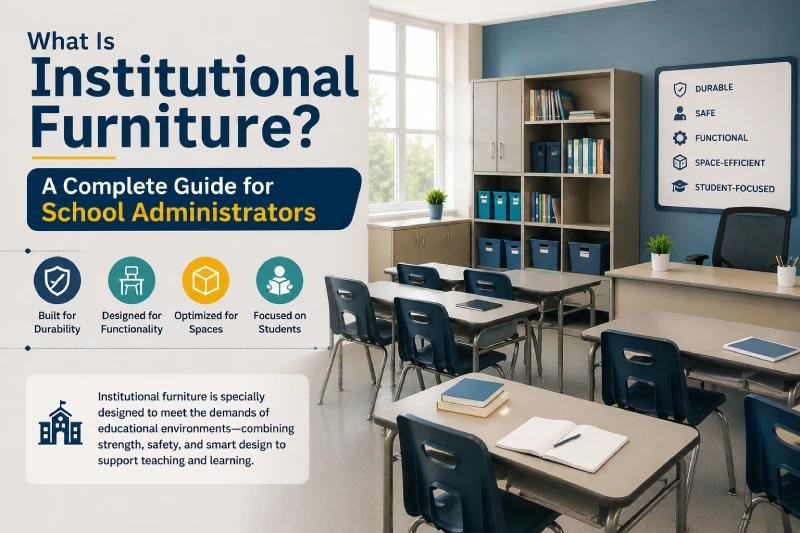
Institutional furniture refers to furniture specifically designed for organisations and public-use environments such as schools, colleges, universities, coaching centres, training institutes, libraries, laboratories, auditoriums, and administrative offices.
Unlike household furniture, institutional furniture is created for frequent use by many people. It is designed to offer durability, safety, comfort, easy maintenance, and functionality in high-traffic spaces.
In educational settings, institutional furniture includes a wide range of products such as:
- Classroom desks and benches
- Student chairs and writing pad chairs
- Teacher tables and chairs
- Library tables, chairs, and book racks
- Laboratory tables and stools
- Auditorium seating
- Podiums and lecterns
- Whiteboards, notice boards, and display boards
- Drawing and drafting tables
- Storage cabinets and key cabinets
- Reception and administrative furniture
In simple terms, institutional furniture supports the daily working of an educational institute. It helps create spaces where students can focus, teachers can teach effectively, and administrators can manage operations smoothly.
Why Is Institutional Furniture Important for Schools and Colleges?
Furniture is often seen as a basic requirement, but its impact on education infrastructure is significant. Poorly designed benches, unstable desks, uncomfortable chairs, or insufficient storage can affect learning, posture, safety, and the overall appearance of an institution.
Well-planned education infrastructure furniture improves the usability of every space within a campus. It helps schools and colleges create an environment that feels organised, welcoming, and professional.
Here are some important reasons why institutional furniture matters.
1. Supports Student Comfort and Concentration
Students spend several hours each day sitting in classrooms. Benches and desks that are uncomfortable, too small, too high, or poorly designed can lead to poor posture and reduced attention.
Ergonomically designed classroom furniture supports better sitting posture and provides enough space for writing, reading, and participating in classroom activities. Comfortable students are more likely to remain focused during lessons.
2. Improves Classroom Functionality
A classroom should allow teachers to move freely, students to sit comfortably, and learning materials to be accessed easily. The right institutional furniture helps create a practical layout that supports teaching and learning.
For example, modular desks can be arranged for group activities, while fixed benches may work well for large classrooms. The best choice depends on the class size, age group, teaching method, and available space.
3. Enhances Safety
Educational institutions need furniture that can withstand regular use without becoming unsafe. Sharp edges, weak joints, unstable frames, and low-quality materials can create risks for students and staff.
Quality institutional furniture is designed with safety in mind. Rounded edges, strong frames, reliable fittings, stable legs, and durable surfaces help reduce the chances of accidents in classrooms, labs, libraries, and other shared spaces.
4. Creates a Professional Campus Environment
The appearance of a school or college influences the perception of students, parents, visitors, and staff. Clean, well-designed, and coordinated furniture gives an institution a more organised and professional identity.
Whether it is a classroom, library, laboratory, or auditorium, the right school and college furniture can make the space more inviting and purposeful.
5. Offers Long-Term Value
Institutional furniture is an investment. Schools and colleges require products that can handle repeated use over many years. Choosing durable furniture may reduce the need for frequent repairs and replacements.
High-quality materials, proper manufacturing, and professional installation help institutions gain better long-term value from their furniture purchases.
Institutional Furniture vs Regular Office Furniture
Many people assume that school furniture and office furniture are similar. While both categories include desks, chairs, storage units, and tables, they are designed for different environments and users.
Regular office furniture is usually created for adults working in corporate or commercial spaces. Institutional furniture, especially for schools and colleges, is designed for students, teachers, staff, and visitors across different age groups.
Here are some key differences.
Designed for Different Users
Office furniture is generally built for adult employees. Institutional furniture may be required for primary school students, senior students, college learners, faculty members, lab users, and administrative staff.
This means dimensions, seating height, desk design, and overall usability must be selected according to the users of each space.
Built for Higher Daily Usage
A classroom bench may be used by multiple students every day for years. Library chairs, lab stools, and auditorium seating also experience continuous use.
Institutional furniture needs stronger construction and durable finishes to handle high usage without losing stability or appearance.
Focused on Learning Requirements
School and college furniture must support educational activities. A drawing table needs angle adjustment and workspace support. A laboratory table must accommodate practical sessions. A library table should support reading and study. An auditorium chair must offer comfort for longer sessions.
These functional needs make institutional furniture different from standard office furniture.
Greater Importance of Safety and Maintenance
Educational campuses often have younger users and large groups moving through shared spaces. Furniture must be easy to clean, safe to use, and suitable for frequent maintenance.
Products with robust materials and practical designs help administrative teams maintain the campus more efficiently.
Major Institute Furniture Types
Every institution has different needs based on its size, curriculum, student strength, available infrastructure, and budget. However, most schools and colleges require a combination of the following institute furniture types.
1. Classroom Furniture
Classroom furniture forms the foundation of a learning environment. It includes student desks, benches, chairs, teacher tables, teacher chairs, storage units, and classroom boards.
The most common classroom furniture options include two-seater benches, three-seater benches, desk-and-bench combinations, individual chairs with desks, and writing pad chairs.
When selecting classroom furniture, administrators should consider student age groups, classroom dimensions, seating capacity, and teaching style. Furniture should allow students to sit comfortably while giving teachers enough space to conduct lessons effectively.
2. Teacher and Faculty Furniture
Teachers need furniture that supports lesson planning, record keeping, student interaction, and day-to-day classroom management.
Faculty furniture may include teacher tables, chairs, storage cabinets, podiums, lecterns, and staff room tables. A well-designed teacher workstation can improve convenience and help maintain an organised classroom environment.
Podiums and lecterns are especially useful in lecture halls, seminar rooms, conference spaces, and auditoriums. They provide a professional speaking area for teachers, guest speakers, and presenters.
3. Library Furniture
A library should be calm, organised, and comfortable. It requires furniture that supports reading, studying, book storage, and easy movement.
Library furniture may include reading tables, study chairs, book racks, magazine stands, newspaper stands, issue counters, display racks, and storage cabinets.
For schools and colleges, library furniture should be selected based on the number of users, available space, book collection size, and the need for individual or group study areas.
4. Laboratory Furniture
Laboratories require specialised furniture because they support practical learning. Science labs, computer labs, language labs, engineering labs, and medical labs all have different requirements.
Laboratory furniture can include worktables, lab stools, storage cabinets, equipment tables, computer tables, and specialised workstations.
Lab furniture should be strong, easy to maintain, and suitable for the specific activities carried out in the space. For example, science labs may need chemical-resistant surfaces, while computer labs need proper cable management and workstation layouts.
5. Auditorium and Seminar Hall Furniture
Auditoriums and seminar halls are used for assemblies, lectures, cultural events, presentations, training sessions, and parent meetings. These spaces need seating that is comfortable, durable, and properly arranged.
Auditorium furniture may include fixed seating, foldable seating, podiums, lecterns, stage furniture, and display boards.
The right seating layout can improve visibility, movement, and audience comfort. It also contributes to the professional look of the institution.
6. Drawing and Drafting Furniture
Architecture, engineering, design, and technical education institutes often require drawing and drafting tables. These tables are designed to provide a stable surface for technical drawing, sketching, and design work.
Adjustable drawing tables can support different working angles and help students work comfortably during long practical sessions. Such furniture is especially useful for colleges offering technical and creative courses.
7. Boards and Display Systems
Boards are an essential part of classroom communication. Whiteboards, green boards, notice boards, display boards, revolving boards, and fixed board stands are used across schools and colleges.
These products support teaching, announcements, presentations, scheduling, and student work displays. Selecting the right board size and type can improve classroom communication and visibility.
8. Storage and Administrative Furniture
Administrative areas require furniture that helps staff manage files, documents, keys, stationery, and daily operations.
Storage furniture may include cabinets, lockers, key cabinets, filing units, cupboards, and reception storage. These products help maintain order and reduce clutter in offices, staff rooms, and administrative departments.
What Should School Administrators Consider Before Buying Institutional Furniture?
Choosing institutional furniture is not only about selecting attractive designs. It requires planning, measurement, and an understanding of how each space will be used.
Here are key factors to consider before placing an order.
Understand the Purpose of Each Space
Every area in an institution has a different purpose. A classroom needs student seating and teacher furniture. A library needs study tables and book storage. A lab needs specialised workstations. An auditorium needs comfortable seating and presentation furniture.
Prepare a room-wise requirement list before beginning the selection process.
Measure the Available Space
Furniture should fit comfortably within the room without making it crowded. Proper spacing is important for movement, cleaning, safety, and emergency access.
Measure the length, width, and layout of each room. Consider doors, windows, electrical points, columns, and existing fixtures before finalising furniture dimensions.
Select Furniture According to Student Age
Furniture for pre-primary students will be very different from furniture for senior school or college students. Desk height, chair height, seat depth, and writing surface size should match the age group.
Using appropriately sized furniture helps students sit comfortably and use the workspace effectively.
Focus on Material Quality
Institutional furniture is used repeatedly, so material quality is essential. Strong metal frames, durable boards, quality laminates, reliable fittings, and sturdy seating materials can improve product life.
Administrators should look for furniture that can withstand daily use while remaining easy to clean and maintain.
Consider Customisation
Every school and college has unique requirements. Some institutions may need furniture in specific sizes, colours, layouts, or branding styles. Others may need custom storage, specialised lab tables, or furniture designed for compact classrooms.
Customised institutional furniture can help institutions make better use of available space while maintaining a consistent campus identity.
Plan for Installation and After-Sales Support
Furniture procurement does not end with delivery. Proper installation is important to ensure stability, safety, and correct placement.
Working with a supplier that understands institutional requirements can make the process smoother—from requirement analysis and product selection to delivery and installation.
How Institutional Furniture Supports Modern Education
Modern education is becoming more interactive, technology-enabled, and student-focused. Classrooms are no longer limited to rows of fixed benches. Many institutions now use flexible layouts for discussions, collaborative learning, presentations, and activity-based teaching.
Institutional furniture can support this shift by offering adaptable and functional solutions. Modular tables, movable chairs, writing pad seating, collaborative desks, and specialised workstations can help institutions create more engaging learning environments.
The right furniture also supports better space utilisation. A thoughtfully designed classroom can accommodate students comfortably while allowing teachers to conduct different types of lessons.
Why Choose Vardhaman Trading for Institutional Furniture?
Vardhaman Trading Company specialises in institutional furniture solutions for schools and colleges. The company offers products across important educational spaces, including classrooms, libraries, laboratories, auditoriums, drawing rooms, and administrative areas.
From benches and boards to podiums, drafting tables, library furniture, lab furniture, and customised solutions, Vardhaman Trading supports institutions in creating practical and durable learning spaces.
A well-planned approach to institutional furniture helps administrators make confident decisions. It ensures that every product is selected according to the needs of students, staff, available space, and long-term infrastructure goals.
Conclusion
Institutional furniture is not simply furniture placed inside a school or college. It is an important part of education infrastructure that influences comfort, safety, organisation, learning, and the overall experience of students and staff.
For school administrators, choosing the right furniture means looking beyond price and appearance. It means selecting solutions that are durable, functional, age-appropriate, easy to maintain, and suitable for the institution’s long-term needs.
Whether you are setting up a new campus, renovating classrooms, upgrading a library, building a laboratory, or planning an auditorium, the right institutional furniture can make a meaningful difference.
With thoughtfully selected school and college furniture, institutions can create learning environments that are ready for today’s needs and prepared for tomorrow’s growth.